How Your Home Is Working Against Your Eyes as You Age — And What to Do About It
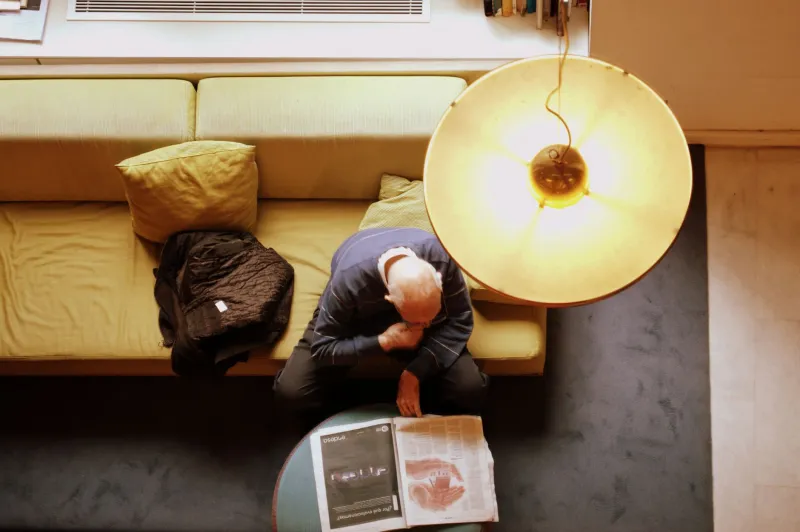
For millions of older Americans, aging in place is not merely a preference — it is a deeply personal commitment to independence. Yet most conversations about home safety center on physical fall prevention: handrails, non-slip mats, and wider doorways. Rarely do these discussions address something equally consequential: the way a home's visual environment quietly compounds the vision challenges that accompany aging.
Your eyes change significantly after 60. The lens stiffens, contrast sensitivity diminishes, glare becomes more disruptive, and the pupil responds more slowly to shifts in lighting. A home that served you well at 45 may, by 70, present a subtle but persistent series of visual obstacles — ones that accumulate over time into real risks for both safety and eye health.
The Lighting Problem No One Talks About
Lighting is the single most impactful variable in a home's visual environment, yet it is also the most commonly mismanaged. Older adults require significantly more light than younger people to achieve the same level of visual clarity — estimates suggest the difference can be as much as three times the illumination. Despite this, most American homes are lit according to the preferences of whoever designed them, which rarely accounts for the needs of aging eyes.
The problem is not simply brightness. It is contrast and consistency. A room that is brightly lit in one area and dimly lit in another forces the aging pupil to work harder during every transition. This repeated adjustment — called dark adaptation — slows considerably with age, meaning a walk from a sun-drenched kitchen to a darker hallway can leave a 75-year-old functionally sightless for several seconds. That window of vulnerability is where falls and misjudgments occur.
Fluorescent overhead lighting introduces a different hazard: glare. As the eye's lens yellows and develops early scattering — even without a diagnosable cataract — diffuse glare from overhead sources creates visual noise that reduces functional vision. Switching to warm-toned LED bulbs positioned at eye level, supplemented by task lighting in reading and work areas, can make a measurable difference in how clearly and comfortably an older adult sees within their own home.
Floors, Transitions, and the Depth Perception Trap
Contrast sensitivity loss is one of aging's most underappreciated visual changes. It affects not just the ability to distinguish objects from backgrounds, but also the perception of depth and surface transitions. This is where flooring choices become a genuine eye health concern.
Homes with uniform flooring — continuous hardwood, monochromatic tile, or wall-to-wall carpeting in a single neutral tone — eliminate the visual cues that help the aging brain interpret spatial information. When a step edge, a threshold, or a change in surface level shares the same color and tone as the surrounding floor, older adults with reduced contrast sensitivity may simply not perceive it. The result is a tripping hazard that has nothing to do with physical coordination and everything to do with visual processing.
Adding high-contrast edge markings, transitional strips in contrasting tones, or area rugs with clearly defined borders can restore the visual landmarks that aging eyes need to navigate safely. These modifications require no structural renovation — only an awareness that the eyes interpret space differently over time.
Window Placement and the Glare Equation
Natural light is beneficial, but unmanaged sunlight entering a home can be a significant source of disruptive glare for older residents. Large west-facing windows, popular in many American residential designs, flood living spaces with low-angle afternoon sun — precisely the angle most likely to create debilitating glare for eyes with even mild lens changes.
The challenge is that natural light is also essential. Vitamin D synthesis, circadian rhythm regulation, and mood stability all depend on meaningful sun exposure. The goal is not to eliminate natural light but to diffuse and direct it. Sheer window treatments, adjustable blinds, and strategically placed furniture that avoids positioning seating areas directly opposite windows can preserve the benefits of natural light while reducing its visual burden.
Antiglare coatings on prescription eyewear are another practical intervention. If you or a family member has not discussed antiglare lens treatment with an eye care professional, it is worth raising at the next comprehensive exam.
Interior Color and the Contrast Deficit
Interior design trends in the United States have long favored neutral, monochromatic palettes — gray-on-gray, white-on-cream, beige-on-taupe. These aesthetic choices, while visually pleasing to younger eyes, can be genuinely disorienting for older adults whose contrast sensitivity has declined.
Consider how a white toilet against a white wall in a white bathroom appears to someone with reduced contrast sensitivity: the boundaries between objects become indistinct, spatial orientation becomes unreliable, and simple tasks become effortful. Adding a contrasting toilet seat cover, painting the wall behind fixtures in a clearly different tone, or placing a colored bath mat can restore the visual definition that makes a bathroom both functional and safe.
Similarly, cabinet hardware, light switch plates, and door handles in high-contrast finishes — dark hardware on light cabinets, or vice versa — provide the visual anchoring points that aging eyes depend on to navigate familiar spaces confidently.
Translating Awareness Into Action
The modifications described here are not expensive or architecturally complex. Many can be implemented over a weekend with materials available at any home improvement store. What they require is a shift in perspective: viewing the home not just as a living space, but as a visual environment that either supports or undermines the eye health of the people inside it.
For older adults committed to aging in place, this perspective is not optional — it is foundational. Scheduling a comprehensive eye exam that includes a discussion of functional vision and contrast sensitivity is a logical starting point. An eye care professional can identify specific visual deficits and offer targeted recommendations that go beyond a new prescription.
The goal, ultimately, is a home that meets you where your eyes are — not where they were twenty years ago. With thoughtful adjustments, that home can be a place of genuine safety, comfort, and continued independence for years to come.